
The autoPET3 Challenge: Automated Lesion Segmentation in Whole-Body PET/CT – Multitracer Multicenter Generalization
MICCAI 2024 Challenge (autoPET3), 2026
Key contributions
- The largest publicly available annotated PSMA PET/CT dataset (597 studies from LMU Munich), enabling multitracer research.
- A compositional generalization benchmark with four held-out tracer–center combinations, two of which were entirely unseen during training.
- A complementary data-centric award category isolating data handling strategies from architecture choices with a fixed baseline model.
- Systematic patient- and lesion-level analysis showing that case difficulty and heterogeneity dominate algorithm differences among top-ranked teams.
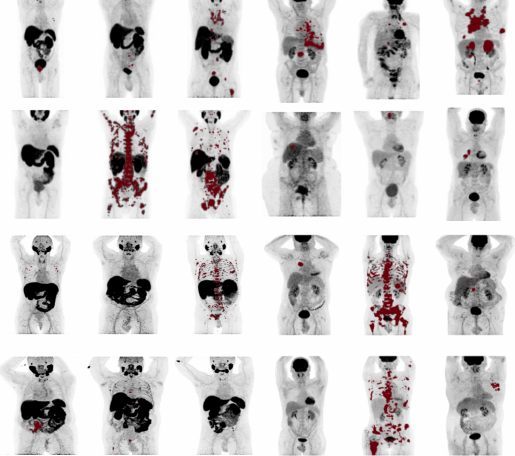
How it works
We report the design and results of the third autoPET challenge (MICCAI 2024), which benchmarked automated lesion segmentation in whole-body PET/CT under a compositional generalization setting. Training data comprised 1,014 [18F]-FDG PET/CT studies from the University Hospital Tübingen and 597 [18F]/[68Ga]-PSMA PET/CT studies from the LMU University Hospital Munich, constituting the largest publicly available annotated PSMA PET/CT dataset to date. The held-out test set of 200 studies covered four tracer–center combinations, two of which represented unseen compositional pairings.
Seventeen teams submitted 27 algorithms, predominantly nnU-Net-based 3D networks with PET/CT channel concatenation. The top-ranked algorithm achieved a mean DSC of 0.66, FNV of 3.18 mL, and FPV of 2.78 mL across all four test conditions, improving DSC by 8% and reducing the false-negative volume by 5 mL relative to the provided baseline. Three main conclusions can be drawn: (1) in-domain multitracer PET/CT segmentation is sufficient and probably approaching reader agreement; (2) compositional generalization to unseen tracer–center combinations remains an open problem mainly driven by systematic volume overestimation; (3) heterogeneity and case difficulty drive performance variation substantially more than the choice of algorithm among top-ranked teams.
Citation
Dexl, J., Jeblick, K., Mittermeier, A., Schachtner, B., Stüber, A. T., Topalis, J., Rokuss, M., Isensee, F., Maier-Hein, K. H., Kalisch, H., Kleesiek, J., Seibold, C. M., Alasmawi, H., Chan, L. Y. L., Yuan, Y., Jaus, A., Stiefelhagen, R., et al. (2026). The autoPET3 Challenge: Automated Lesion Segmentation in Whole-Body PET/CT – Multitracer Multicenter Generalization. MICCAI 2024 Challenge (autoPET3). arXiv:2605.05775.