
Every Component Counts: Rethinking the Measure of Success for Medical Semantic Segmentation in Multi-Instance Segmentation Tasks
Proceedings of the AAAI Conference on Artificial Intelligence 2025, 2025
Key contributions
A connected-component-wise evaluation protocol that removes the size bias in Dice, Surface Dice and Hausdorff distance.
A proximity-based matching that pairs each predicted component with the nearest ground-truth lesion and evaluates metrics locally.
A drop-in metric suite that avoids the counting/overlap pitfalls of Panoptic Quality for multi-instance medical segmentation.
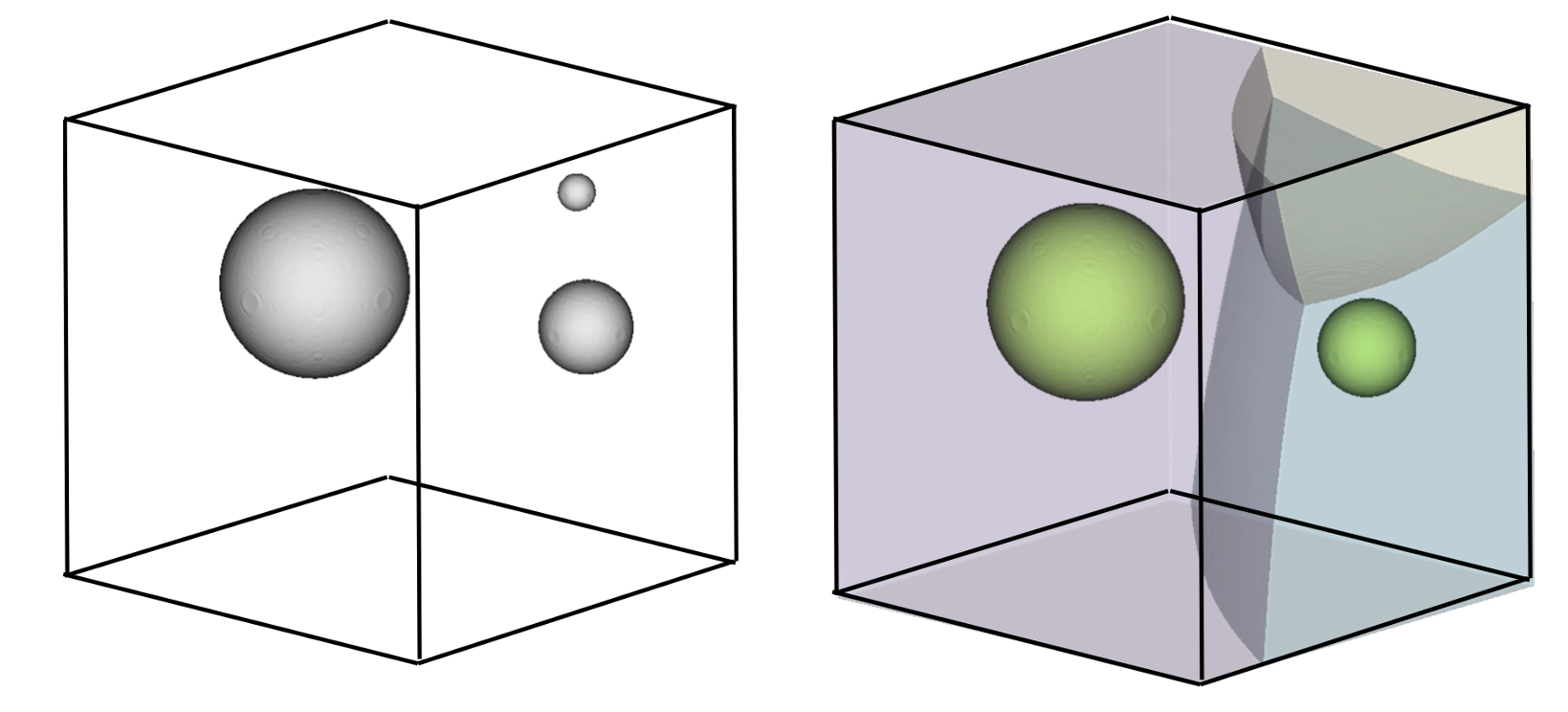
We present Connected-Component~(CC)-Metrics, a novel semantic segmentation evaluation protocol, targeted to align existing semantic segmentation metrics to a multi-instance detection scenario in which each connected component matters.
We motivate this setup in the common medical scenario of semantic metastases segmentation in a full-body PET/CT. We show how existing semantic segmentation metrics suffer from a bias towards larger connected components contradicting the clinical assessment of scans in which tumor size and clinical relevance are uncorrelated. To rebalance existing segmentation metrics, we propose to evaluate them on a per-component basis thus giving each tumor the same weight irrespective of its size.
To match predictions to ground-truth segments, we employ a proximity-based matching criterion, evaluating common metrics locally at the component of interest. Using this approach, we break free of biases introduced by large metastasis for overlap-based metrics such as Dice or Surface Dice. CC-Metrics also improves distance-based metrics such as Hausdorff Distances which are uninformative for small changes that do not influence the maximum or 95th percentile, and avoids pitfalls introduced by directly combining counting-based metrics with overlap-based metrics as it is done in Panoptic Quality.
Explore it yourself
detected missed — click a lesion to toggle
lesions found: – / –
All lesions detected — the two metrics agree.
Citation
Jaus, Alexander; Seibold, Constantin; Reiß, Simon; Marinov, Zdravko; Li, Keyi; Ye, Zeling; Krieg, Stefan; Kleesiek, Jens; Stiefelhagen, Rainer; . (2024). "Every Component Counts: Rethinking the Measure of Success for Medical Semantic Segmentation in Multi-Instance Segmentation Tasks." Proceedings of the AAAI Conference on Artificial Intelligence 2025.