
GRASPing Anatomy to Improve Pathology Segmentation
Machine Learning in Medical Imaging (MLMI), held with MICCAI 2025, 2025
Key contributions
- GRASP (Guided Representation Alignment for the Segmentation of Pathologies): a modular framework that leverages off-the-shelf anatomy models without retraining them.
- A dual anatomy injection strategy: anatomical pseudo-labels as extra input channels combined with transformer attention-based feature fusion.
- Top-ranking performance across two challenging PET/CT datasets and four evaluation metrics with multiple backbone architectures.
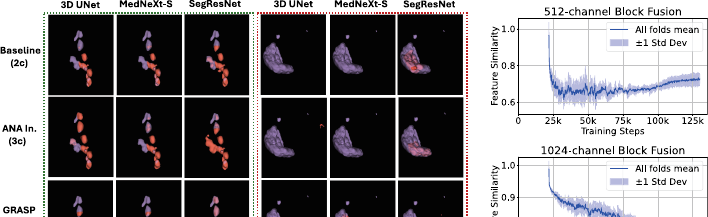
- Systematic ablation comparing fine-tuning, multi-class supervision, multi-task learning, and GRASP — with analysis of feature similarity and anatomy model influence.
How it works
Radiologists rely on anatomical understanding to accurately delineate pathologies, yet most current deep learning approaches use pure pattern recognition and ignore the anatomical context in which pathologies develop. To narrow this gap, we introduce GRASP (Guided Representation Alignment for the Segmentation of Pathologies), a modular plug-and-play framework that enhances pathology segmentation models by leveraging existing anatomy segmentation models through pseudo-label integration and feature alignment.
Unlike previous approaches that obtain anatomical knowledge via auxiliary training, GRASP integrates into standard pathology optimization regimes without retraining anatomical components. We evaluate GRASP on two PET/CT datasets, conduct systematic ablation studies, and investigate the framework’s inner workings. We find that GRASP consistently achieves top rankings across multiple evaluation metrics and diverse architectures. The framework’s dual anatomy injection strategy, combining anatomical pseudo-labels as input channels with transformer-guided anatomical feature fusion, effectively incorporates anatomical context.
Citation
Li, K., Jaus, A., Kleesiek, J., & Stiefelhagen, R. (2025). GRASPing Anatomy to Improve Pathology Segmentation. In Z. Cui et al. (Eds.), MLMI 2025 Workshops, LNCS 16241, pp. 487–497. Springer Nature Switzerland.