
Learning to Look Closer: A New Instance-Wise Loss for Small Cerebral Lesion Segmentation (Oral)
IEEE International Symposium on Biomedical Imaging (ISBI), 2026
Key contributions
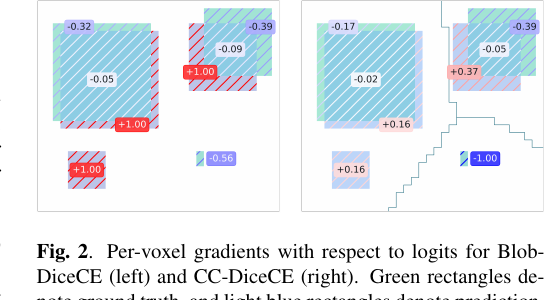
- CC-DiceCE: a connected-component-wise loss derived from the CC-Metrics framework, giving equal weight to every lesion regardless of size.
- The first rigorous multi-dataset comparison of instance-wise losses (CC-DiceCE and blob loss) against a properly configured nnU-Net baseline across five heterogeneous brain MRI datasets.
- Empirical evidence that CC-DiceCE improves lesion detection (recall) with minimal precision trade-offs, and generally outperforms blob loss.
How it works
Traditional loss functions in medical image segmentation, such as Dice, often under-segment small lesions because their small relative volume contributes negligibly to the overall loss. To address this, instance-wise loss functions and metrics have been proposed to evaluate segmentation quality on a per-lesion basis. We introduce CC-DiceCE, a loss function based on the CC-Metrics framework, and compare it with the existing blob loss.
Both are benchmarked against a DiceCE baseline within the nnU-Net framework, which provides a robust and standardized setup. We find that CC-DiceCE loss increases detection (recall) with minimal to no degradation in segmentation performance, though with dataset-dependent trade-offs in precision. Furthermore, our multi-dataset study — spanning five heterogeneous brain MRI datasets including lacunes, cerebral microbleeds, brain metastases, white matter hyperintensities, and gliomas — shows that CC-DiceCE generally outperforms blob loss.
Citation
Bouteille, L., Jaus, A., Kleesiek, J., Stiefelhagen, R., & Heine, L. (2026). Learning to Look Closer: A New Instance-Wise Loss for Small Cerebral Lesion Segmentation. In 2026 IEEE 23rd International Symposium on Biomedical Imaging (ISBI). IEEE. https://doi.org/10.1109/ISBI61048.2026.11515682