
Semantic Segmentation for Preoperative Planning in Transcatheter Aortic Valve Replacement
Statistical Atlases and Computational Models of the Heart (STACOM), held with MICCAI 2025, 2025
Key contributions
- A mapping of TAVR preoperative-planning guidelines onto semantic-segmentation tasks for the relevant cardiac and vascular structures.
- Fine-grained TAVR-relevant pseudo-labels derived from coarse anatomical labels — released publicly together with the CT scans.
- The focal skeleton recall loss, improving thin-structure segmentation by +1.27% Dice.
How it works
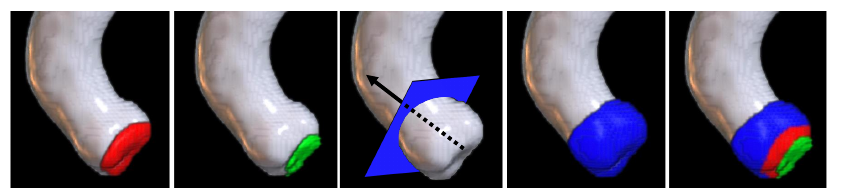
When preoperative planning for surgeries is conducted on the basis of medical images, artificial intelligence methods can support medical doctors during assessment. In this work, we consider medical guidelines for preoperative planning of the transcatheter aortic valve replacement (TAVR) and identify tasks that may be supported via semantic segmentation models by making relevant anatomical structures measurable in computed tomography scans.
We first derive fine-grained TAVR-relevant pseudo-labels from coarse-grained anatomical information, in order to train segmentation models and quantify how well they are able to find these structures in the scans. Furthermore, we propose an adaptation to the loss function in training these segmentation models — the focal skeleton recall loss — and through this achieve a +1.27% Dice increase in performance. Our fine-grained TAVR-relevant pseudo-labels and the computed tomography scans we build upon are made publicly available.
Citation
Zöllner, C., Reiß, S., Jaus, A., Sholi, A., Sodian, R., & Stiefelhagen, R. (2025). Semantic Segmentation for Preoperative Planning in Transcatheter Aortic Valve Replacement. Statistical Atlases and Computational Models of the Heart (STACOM), held with MICCAI 2025.