
Towards Unifying Anatomy Segmentation: Automated Generation of a Full-Body CT Dataset
2024 IEEE International Conference on Image Processing (ICIP), 2024
Key contributions
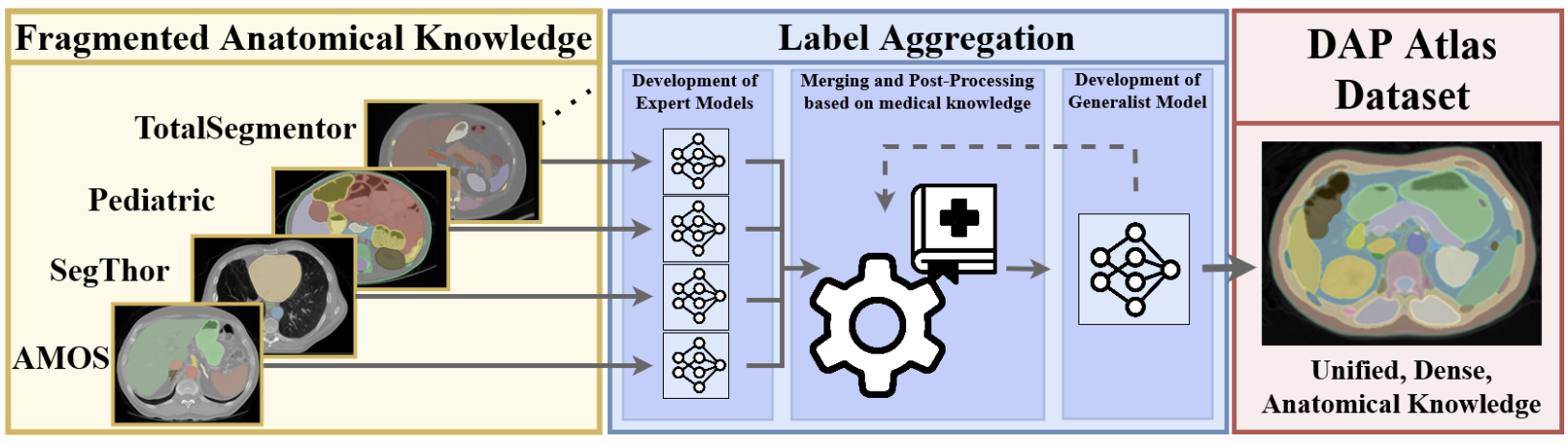
A fully automated pseudo-label aggregation and refinement pipeline that combines fragmented anatomical knowledge from 11 public datasets into a single dense label set covering 142 structures.
Anatomy-guided post-processing rules derived from textbook knowledge that correct spatial inconsistencies and generate 7 novel labels unavailable in any source dataset.
The first publicly released dense, voxel-wise full-body CT dataset (533 volumes, 142 structures), enabling holistic anatomy segmentation for clinical tasks such as body composition analysis and cancer monitoring.
Expert radiologist validation and out-of-distribution benchmarking (85% Dice on BTCV without fine-tuning), demonstrating that automated pseudo-labelling can match the plausibility of expert annotations at scale.
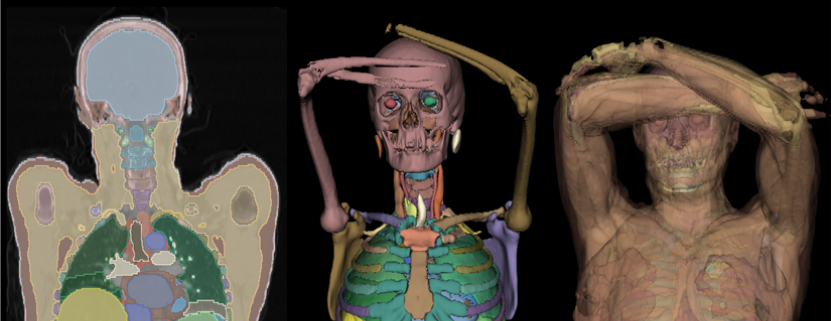
We present the DAP Atlas dataset, a large-scale full-body CT dataset with dense voxel-level annotations for 142 anatomical structures, generated without manual annotations.
We address the limitation of current medical image segmentation models that focus only on isolated body regions by developing a holistic full-body anatomical dataset. Recognizing the impracticality of large-scale expert annotations for hundreds of structures, we employ a fully automated pseudo-label aggregation and refinement strategy to generate high-quality labels without direct expert involvement.
Inspired by approaches from natural image segmentation, we combine scattered anatomical knowledge from multiple sources and ensure anatomical plausibility through post-processing techniques guided by textbook anatomy. We aggregate fragmented knowledge from public datasets and refine labels using anatomical rules, which allows us to automate dataset creation and develop a unified segmentation model.
Our resulting dataset comprises 533 whole-body CT scans annotated with 142 anatomical structures, marking the first release of dense, voxel-wise full-body CT annotations. This dataset enables training of models for diverse clinical applications, such as body composition analysis, surgery planning, and cancer treatment monitoring, without the bottleneck of manual labeling.
The approach is validated through expert reviews, anatomical plausibility checks, and out-of-distribution performance (85% Dice on BTCV without fine-tuning). The dataset and models are publicly available to foster research in holistic medical image segmentation.
Explore it yourself
Scroll here to load the interactive viewer…
Citation
Jaus, Alexander; Seibold, Constantin; Hermann, Kelsey; Shahamiri, Negar; Walter, Alexandra; Giske, Kristina; Haubold, Johannes; Kleesiek, Jens; Stiefelhagen, Rainer; . (2024). "Towards Unifying Anatomy Segmentation: Automated Generation of a Full-Body CT Dataset." 2024 IEEE International Conference on Image Processing (ICIP): 41-47.