
Anatomy-guided Pathology Segmentation
International Conference on Medical Image Computing and Computer-Assisted Intervention, 2024
Key contributions
- A systematic ablation of strategies for incorporating learned anatomical knowledge into pathology segmentation.
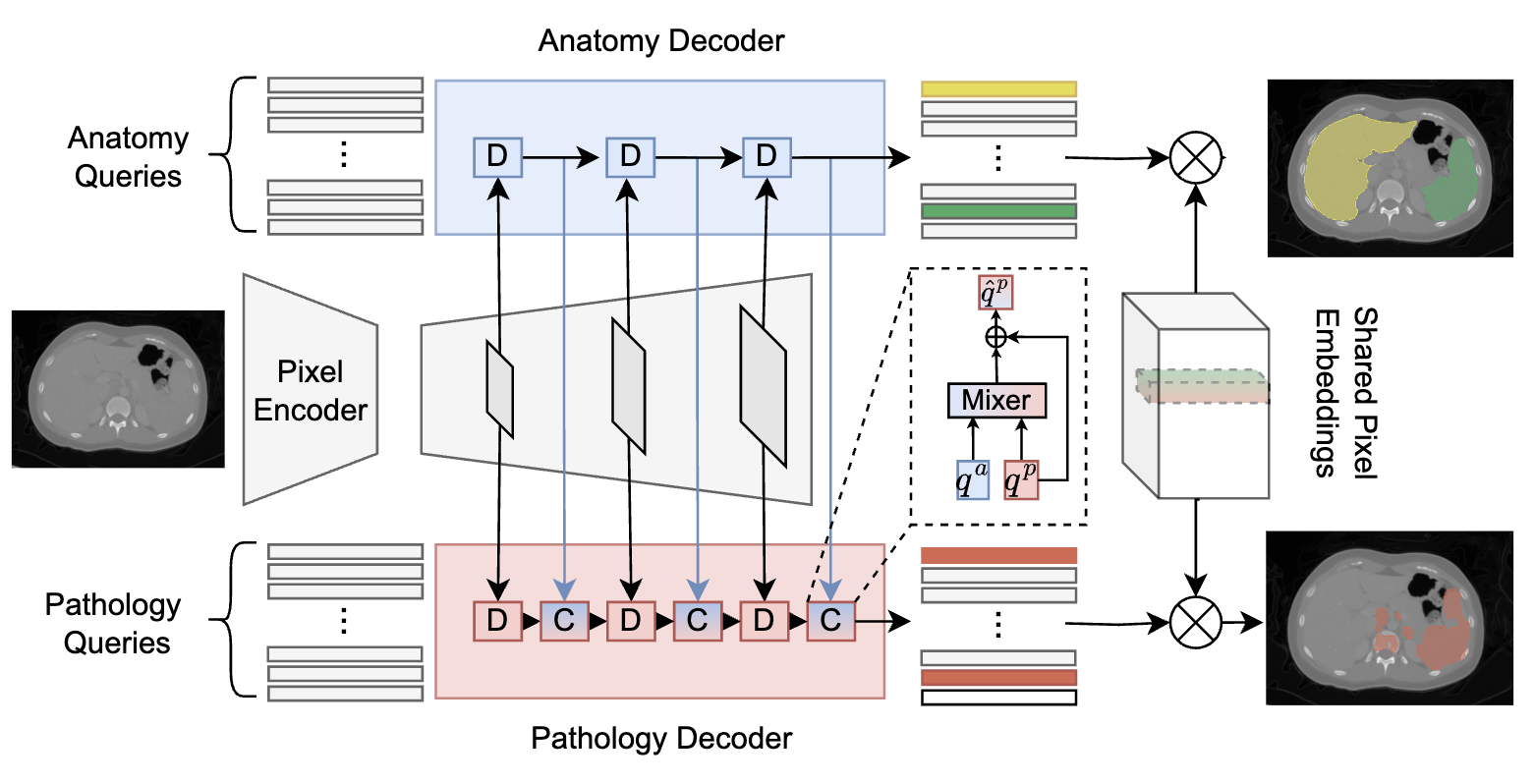
- APEx (Anatomy-Pathology Exchange): a query-based transformer that interleaves anatomy representations into the pathology decoder via learned query mixing.
- State-of-the-art results on FDG-PET-CT (+2.0%) and ChestXDet (+3.3% mAP) over strong Mask2Former baselines.
How it works
Pathological structures in medical images are typically deviations from the expected anatomy of a patient. While clinicians consider this interplay between anatomy and pathology, recent deep learning algorithms specialize in recognizing either one of the two, rarely considering the patient’s body from such a joint perspective. In this paper, we develop a generalist segmentation model that combines anatomical and pathological information, aiming to enhance the segmentation accuracy of pathological features. Our Anatomy-Pathology Exchange (APEx) training utilizes a query-based segmentation transformer which decodes a joint feature space into query-representations for human anatomy and interleaves them via a mixing strategy into the pathology-decoder for anatomy-informed pathology predictions. In doing so, we are able to report the best results across the board on FDG-PET-CT and Chest X-Ray pathology segmentation tasks with a margin of up to 3.3% as compared to strong baseline methods. Code and models will be publicly available at github.com/alexanderjaus/APEx.
Citation
Jaus, Alexander; Seibold, Constantin; Reiß, Simon; Heine, Lukas; Schily, Anton; Kim, Moon; Bahnsen, Fin Hendrik; Herrmann, Ken; Stiefelhagen, Rainer; Kleesiek, Jens; . (2024). "Anatomy-guided Pathology Segmentation." International Conference on Medical Image Computing and Computer-Assisted Intervention: 3-13.